


On display now on the first floor Library landing showcases the poetic interpretation of three of Wagner's operas by Irish poet, critic, and journalist Thomas William Hazen Rolleston, illustrated by American-Hungarian artist Willy Pogány.
Just three of many you can use in your studies (or for fun!)
These books are just a few of the many wonderful illustrated books and works of graphic art, architectural imagination, natural history illustration and more that for preservation reasons are kept locked away in our Rare Books room. All of them are available for you to request, inspect, and photograph, and it would be amazing to help you dig into your subjects more deeply.

The poet
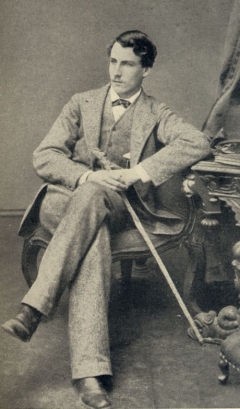
This poetic interpretation of the Wagnerian operatic trilogy, Tannhäuser (1911), Parsifal (1912), and Lohengrin (1913), were written by the Irish poet, critic and journalist Thomas William (TW) Hazen Rolleston (1857–1920), poet, critic and journalist in his later life after returning to the Irish literary scene later in life while living in London, and illustrated by the prodigious Hungarian-American folklore illustrator and artist Willy Pogány.
Rolleston was born the youngest of four children of a barrister father, while his mother was a County Court Judge and Baron of the Court of Exchequer in Ireland. He followed in his parents' footsteps, graduating from Trinity College Dublin and winning the vice-chancellor's prize for English verse. After time spent in Germany to treat his wife’s rheumatism, where he published a biography of German philosopher Gotthold Lessing about whom he later delivered Taylorian lectures at Oxford University, he returned to Ireland and co-founded the Dublin University Review with Charles Hubert Oldham in 1885, and went on to publish the first works by WB Yeats and the first English translations of Russian author Turgenev.
Considered a better critic and organiser than a poet, he managed the Irish Industries Association (1894–7) and was honorary secretary of the Arts and Crafts Society of Ireland (1898–1908), working as a central organiser, lecturer, propagandist and critic rather than an author, editing the society's journal and seeking to embed the arts and crafts revival in a changing culture.
He finally settled in London in 1909, after being offered the editorship of the German language and literature section of the Times Literary Supplement, published several works based on Irish myth and Wagnerian operas, including the poetical interpretations of Wagner's operas currently on display, and during the First World War became librarian for the Ministry of Information, where he used his knowledge of Irish in the "Obscure Languages" section of the Censor's Department.
Rolleston died suddenly on 5 December 1920 at his home in Hampstead, London. His widow donated many of his books to Cork Public Library.
The illustrator
This poetic interpretation of the Wagnerian operatic trilogy, Tannhäuser (1911), Parsifal (1912), and Lohengrin (1913) on display were illustrated by the famous Hungarian-born artist, painter, illustrator, muralist, architect, stage designer, film art director, and sculptor Willy Pogány while he was living in London, shortly before he departed for America in 2014, where he naturalised in 2021.
Pogány illustrated over 100 books in a notable variety of artistic styles. Of these, this trilogy are considered among his greatest masterpieces. Pogány’s other illustrations include folk lore and fairy tales, including classical interpretations of Little Red Riding Hood and Cinderella, as well as W. Jenkyn Thomas's The Welsh Fairy Book (1907) and Nandor Pogány's Magyar Fairy Tales from Old Hungarian Legends (1930).
Pogány attended Budapest Technical School for less than a year and took an art class for only six weeks before teaching himself art as he travelled. Multilingual and known across Europe, he worked for illustrators including Fischer, Unwin and Hutchinson before Harrap's Treasury of Verse for Children introduced his work to the American market.
Pogány won gold medals at the Budapest Expo, Leipzig Expo, the London Masonic Medal, and finally became a Fellow in the London Royal Society of Art. He moved to New York City to illustrate the covers of Metropolitan Magazine, Ladies Home Journal, Harper's Weekly, Hearst's Town and Country, Theatre Magazine, and American Weekly, designed sketches, scenery and costumes for the New York Metropolitan Opera before being commissioned to paint large scale murals, still surviving, in August Heckscher's Children's Theatre depicting scenes from fairy stories for which he won a prestigious medal from the New York Society of Architects and in the Eldorado Hotel, and a silk mural at Wanamaker's Department Store celebrating 300 years of New York History as well as many others.
Pogány moved from New York to Hollywood, where he designed sets for every major studio, which continued until the late 1930s while also designing the estates of the well to do and painting portraits of contemporary celebrities. In 1931, while he was living in Hollywood, he completed the Earl Carroll Theatre Sculpture and the 1932 Olympic Postage Stamp, which won him a medal.
During Pogány's later years, he moved back to New York where he completed three books dealing with drawing lessons, oil painting techniques and an illustration book for children, illustrated the cover art for American Weekly and continued painting portraits of successive New York mayors.
Whether illustrating Wagner or swimsuit sirens, Shakespeare or huge murals, Pogány’s work was always inventive, evolving, and eclectic, switching between artistic styles showing a range beyond that which most artists are capable. He also wrote instructional books on drawing and painting with oils and watercolours.
Willy Pogány died on 30 July 1955.
Sources
- Scapple, S. (2015). Pogány, Willy (1882-1955). In J. Zipes (Ed.), The Oxford companion to fairy tales (2nd ed.). Oxford University Press. https://access.infobase.com/book/574305-oxford-companion-to-fairy-tales
- Murphy, W. (n.d.). Rolleston, Thomas William Hazen (T. W.). In Dictionary of Irish Biography. Royal Irish Academy. https://www.dib.ie/biography/rolleston-thomas-william-hazen-t-w-a7782
- Willy Pogany (1882-1955). American Art Archives. https://www.americanartarchives.com/pogany,w.htm
- Biography: William Pogany. Architecturals.net Restoration Center. https://www.architecturals.net/biography-willy-pogany/