


If people are all good, where does evil come from?
Philosophers have been debating this question for millennia. I want to look into a more specific form of discrimination this LGBTQ+ History Month: where does discrimination come from? Some would have us believe discrimination happens because diversity exists. Exterminate everyone who is not able-bodied, white, cis-gendered, heterosexual, and fits into the stereotypical mould of the 'typical' or (worse) 'normal' citizen and everyone left standing will experience instant bliss. Psychologists have looked into what is happening here and discovered that everyone experiences disgust at anything unfamiliar. This primitive reaction has kept us alive: in the wild, something unfamiliar is often venomous, vicious, predatory, or poisonous. Leaving well enough alone kept our ancestors alive.
We now live in a diverse and multicultural society, yet many people don't mix with anyone who does not believe and behave just like themselves until they are old enough that the rest of society triggers this disgust reaction in them. Worse, most people have been indoctrinated with the belief that they are somehow special and everyone unlike them is a threat, competition to be driven away, or the stuff of nightmares bred to harm them. Such childhood conditioning is powerful and endures. The argument runs that the hard-wired disgust reaction everyone experiences when they encounter anything different and unexpected should be privileged above the lives and livelihoods of anyone who happens to trigger that reaction in those similar enough in superficial appearance to feel comfortable together. During straitened times, people look at others with envious eyes - a dangerous behaviour that leaves people vulnerable to the whispering campaigns of the far right that has seen attitudes to people of the global majority, women, sexually and gender diverse people eroded at the cost of social cohesion, happiness, and distracted many people from who is actually benefiting while they suffer financially.
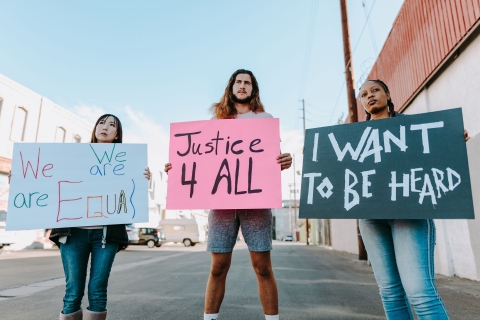
Fear of change
"To those with privilege, equality feels like oppression" - Anon.
We all fear change, and we are hardwired biologically to fear losing what we have more than hoping to gain from change. These are powerful forces maintaining the status quo. The recent deterioration of global stability has also damaged faith in the existing structures that kept most people safe. Many also openly fear that equality will mean everyone being forced to subsist at the level of the poorest in society, rather than seeing equality as a rising tide that offers to float all boats.
Discrimination is cultivated
Fear and discrimination are not hatched in a vaccuum, the fears and stories we tell ourselves about the world are inherited, systematically nurtured, and weaponised to divide society and turn a profit. From selling newspapers to MAGA hats, national flags and other paraphernalia racism and transphobia risk have long been part of some subcultural identities. People bond together over what they hate.
Discrimination ultimately happens because everyone is prejudiced in all manner of ways but very few are willing to look inside, notice the ugliness of their thoughts and question them. Happily, you are not your thoughts. You will have many thoughts, some good, some horrifying, and others downright silly - the question is whether you take the time to notice them and choose which to act upon and which you let drive you on autopilot. Racism, sexism, transphobia and so on are all signs of deep ignorance and a brain on autopilot following received instruction without question. They persist because watching the mind and questioning what we think we already know is uncomfortable and requires effort.
To adapt a line from a wise character from a very silly but exceptionally good cartoon: "Some people are willing to do the work, while others would rather tear the world apart or die trying to avoid it. We all get to choose."
Breaking the cycle of discrimination
We can work to break the cycle that normalises discrimination in many ways and it has never been more important:
- Realise our own power and privilege and use it responsibly by being an active bystander, challenging friends and colleagues when they say or do things that are not acceptable - why not sign up to become a local StepUp, SpeakUp champion
- Use our privilege to give power to those to those who do not have it and amplify their voices
- Raising awareness of the inequalities that result from unearned privilege
- Challenging systems of oppression - including those that give us power
- Build empathy by widening your social circle, connecting with people you would not ordinarily mix with and expose yourself to different stories about the world
Disclaimer
Contributed by David E Bennett
The views contained in this blog post are the author's own and may differ from those of his employer.