

Good notes help you understand, remember and use what you learn. This page presents the essentials of notetaking, more advanced approaches to adding to your notes over time, and a list of common abbreviations and symbols to help you write faster.
Contents
Essential
- Choose a method that fits your task
- Choosing between handwritten or digital notes
- Preparation
- Focus on key ideas
- Review your notes
Advanced
Abbreviations and symbols
Essential guidance
Choose a method that fits your task (before your session)
Different methods help you organise ideas in different ways. You can change your method depending on the task.
- What it is: Notes written in order using headings and sections.
- Useful when: You want a clear record of the structure of a lecture, seminar or text.
- Limitation: May not show deeper links between ideas.
Below, Figure 1 shows a blank example of linear notes, and Figure 2 shows an example of a completed set of linear notes.
|
Figure 1. A blank outline template for linear notes. It shows how headings, points, and extra details can be organised.
|
Figure 2. An example of linear notes from a lecture on renewable energy.
- What it is: A page split into notes, keywords, and a summary.
- Useful when: You want to organise ideas and review them later.
- Limitation: Takes more time to organise.
Below, Figure 3 shows a blank example of Cornell notes, and Figure 4 shows an example of a completed set of Cornell notes.
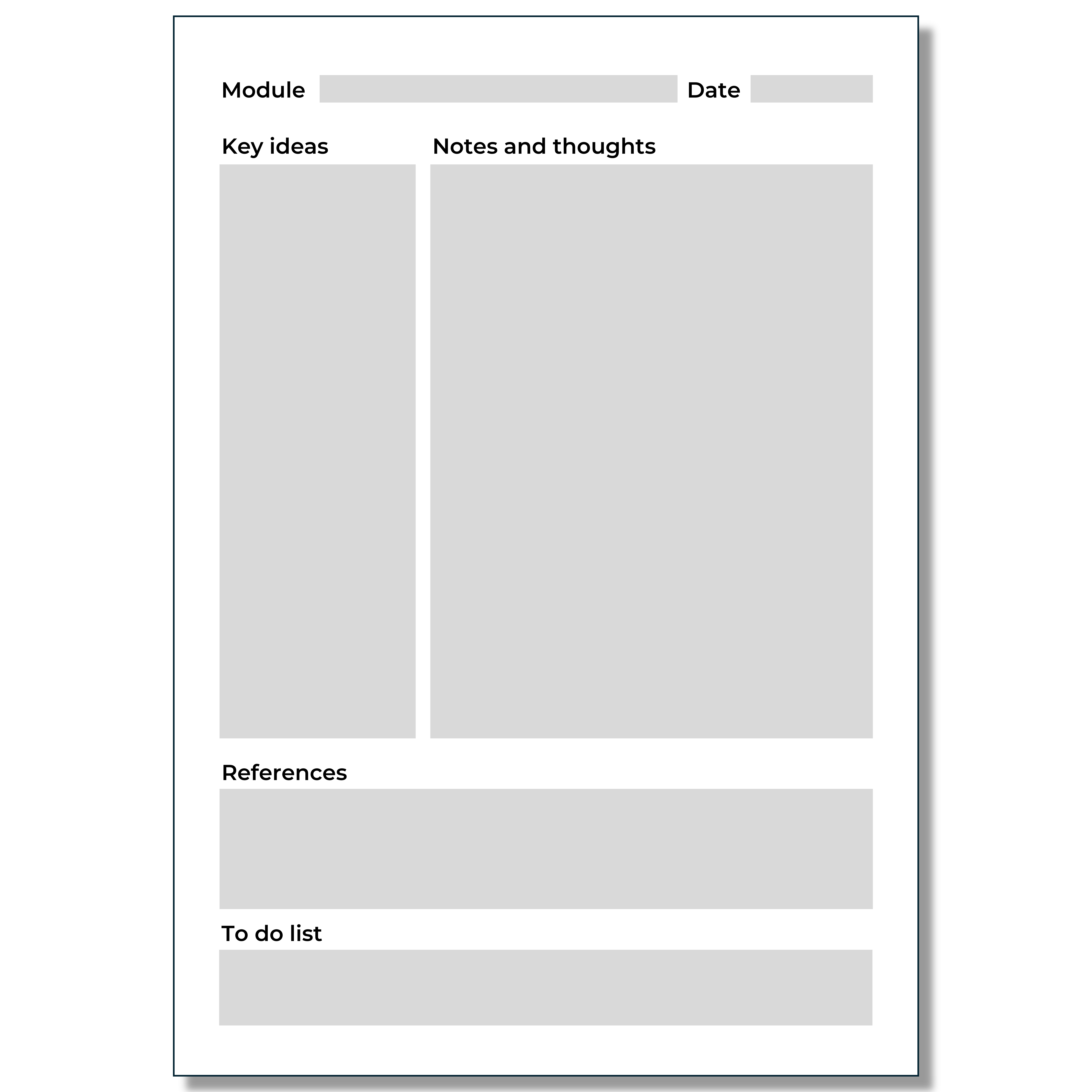
Figure 3. A blank Cornell notes template, ready to be filled in during or after a lecture.
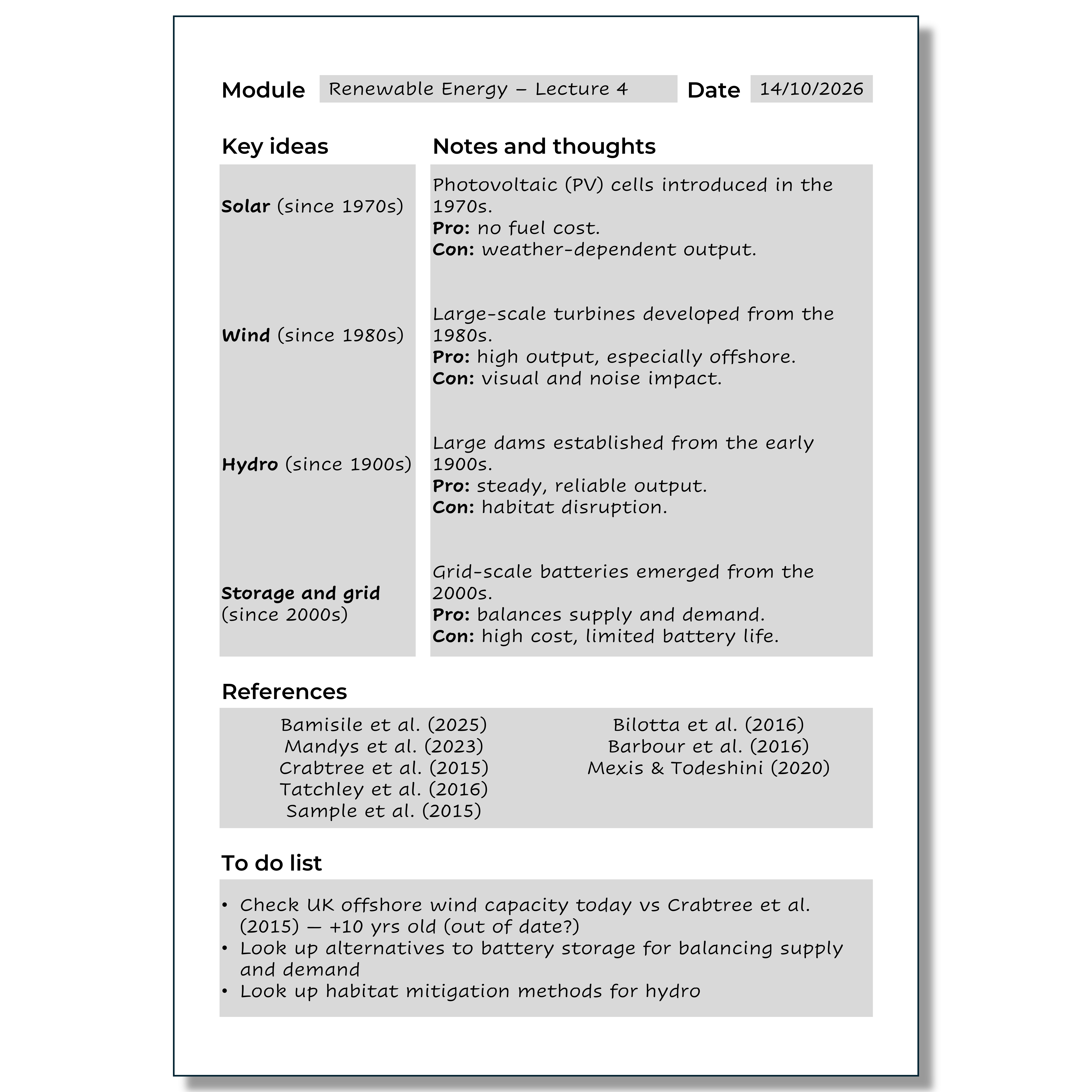
Figure 4. An example of a completed Cornell notes template, showing key ideas, expanded notes, references, and a to-do list for follow-up research (downloadable version of example (Word, 20KB)).
You can download templates using these links:
- What it is: A central idea with branches showing related ideas.
- Useful when: You want to see how ideas connect across a topic.
- Limitation: Can become messy if the topic is very detailed.
Below, Figure 5 shows a blank example of a mind map, and Figure 6 shows an example of lecture notes written in the style of a mind map.
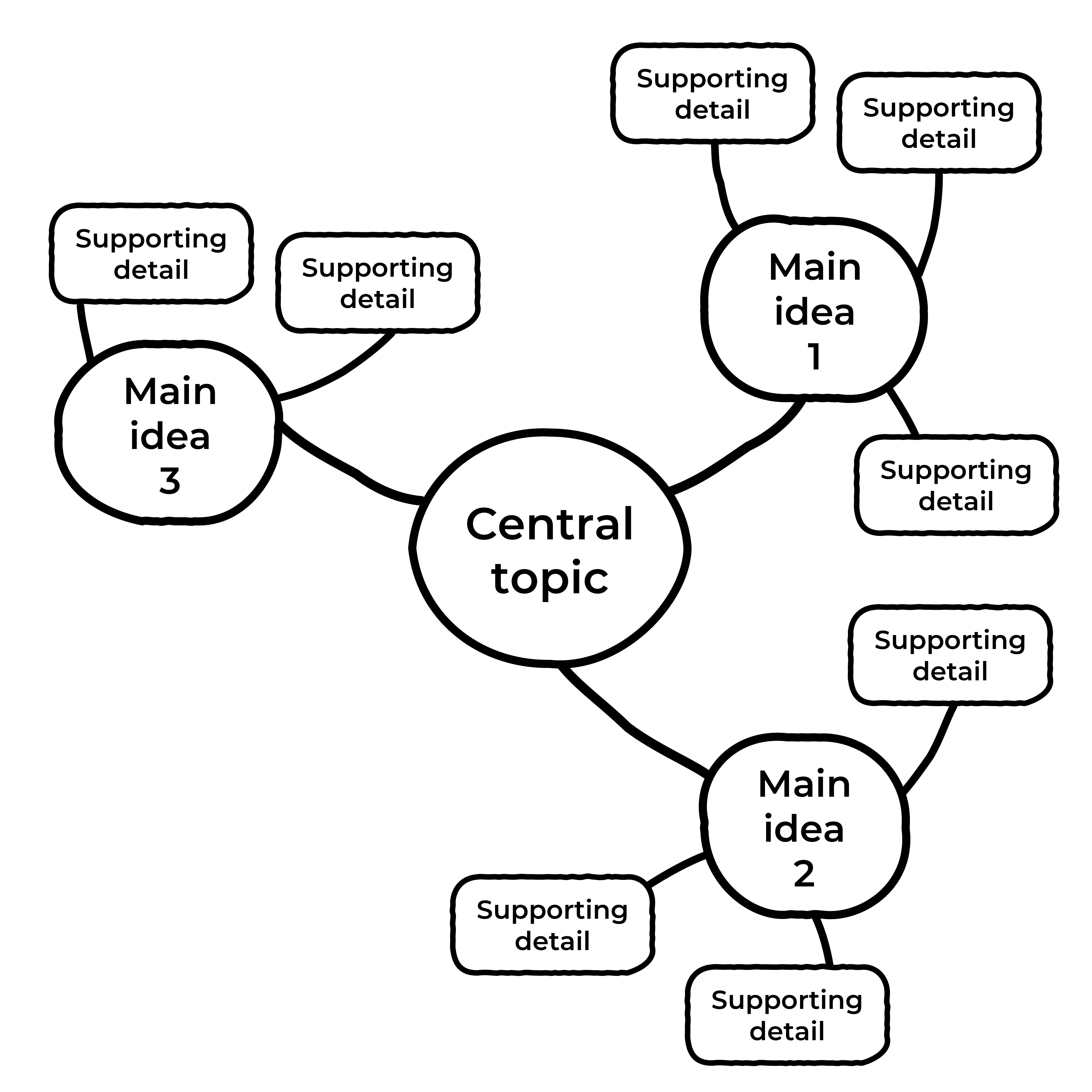
Figure 5. A blank mind map template, showing the basic structure of a central topic, main ideas, and supporting details.
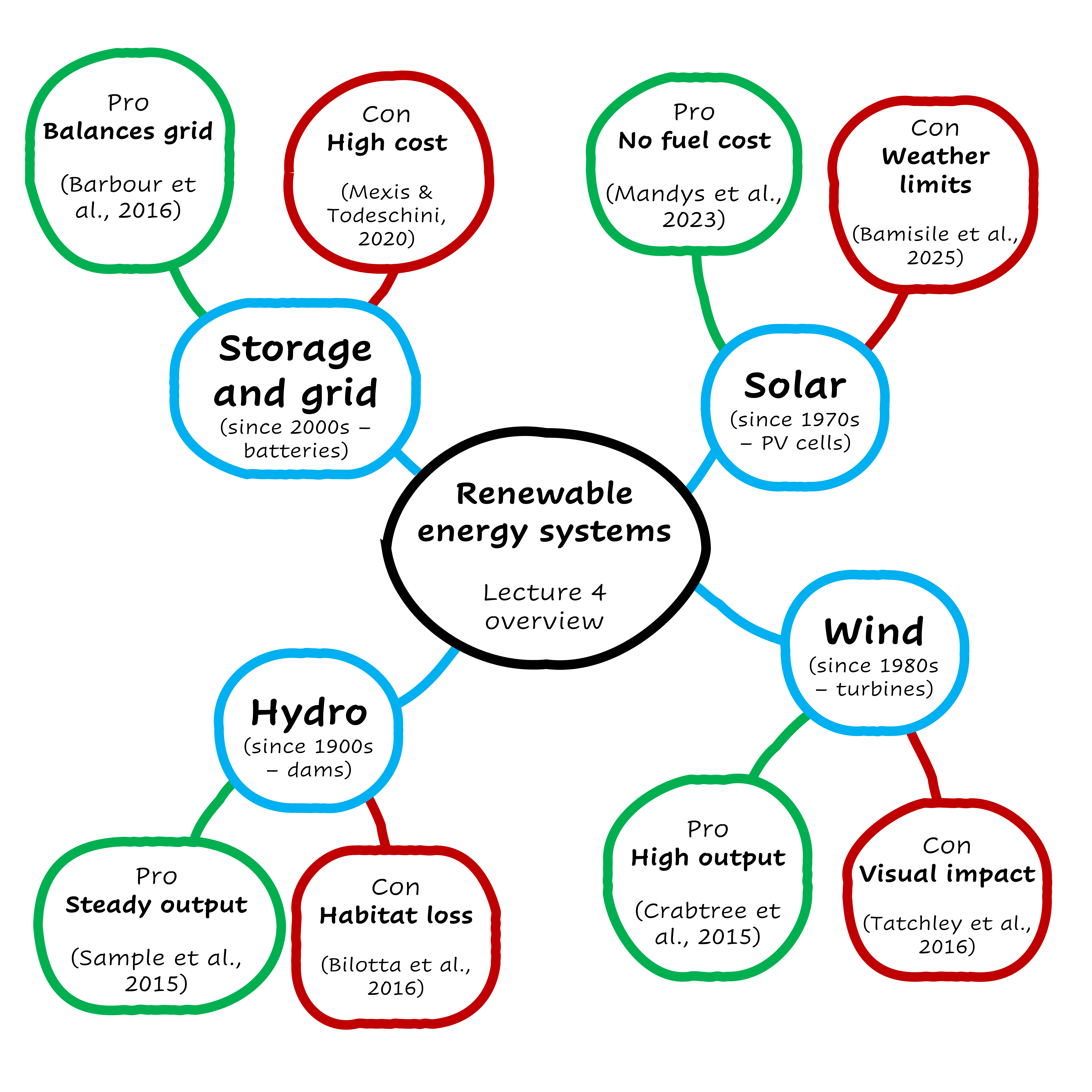
Figure 6. An example of a completed mind map, showing how a central topic branches into key themes, then into supporting pros, cons, and references.
Bamisile, O., Acen, C., Cai, D., Huang, Q., & Staffell, I. (2025). The environmental factors affecting solar photovoltaic output. Renewable and Sustainable Energy Reviews, 208, Article 115073. https://doi.org/10.1016/j.rser.2024.115073
Barbour, E., Wilson, I. A. G., Radcliffe, J., Ding, Y., & Li, Y. (2016). A review of pumped hydro energy storage development in significant international electricity markets. Renewable and Sustainable Energy Reviews, 61, 421–432. https://doi.org/10.1016/j.rser.2016.04.019
Bilotta, G. S., Burnside, N. G., Gray, J. C., & Orr, H. G. (2016). The effects of run-of-river hydroelectric power schemes on fish community composition in temperate streams and rivers. PLOS ONE, 11(5), Article e0154271. https://doi.org/10.1371/journal.pone.0154271
Crabtree, C. J., Zappalá, D., & Hogg, S. I. (2015). Wind energy: UK experiences and offshore operational challenges. Proceedings of the Institution of Mechanical Engineers, Part A: Journal of Power and Energy, 229(7), 727–746. https://doi.org/10.1177/0957650915597560
Mandys, F., Chitnis, M., & Silva, S. R. P. (2023). Levelized cost estimates of solar photovoltaic electricity in the United Kingdom until 2035. Patterns, 4(4), Article 100735. https://doi.org/10.1016/j.patter.2023.100735
Mexis, I., & Todeschini, G. (2020). Battery energy storage systems in the United Kingdom: A review of current state-of-the-art and future applications. Energies, 13(14), Article 3616. https://doi.org/10.3390/en13143616
Sample, J. E., Duncan, N., Ferguson, M., & Cooksley, S. (2015). Scotland's hydropower: Current capacity, future potential and the possible impacts of climate change. Renewable and Sustainable Energy Reviews, 52, 111–122. https://doi.org/10.1016/j.rser.2015.07.071
Tatchley, C., Paton, H., Robertson, E., Minderman, J., Hanley, N. D., & Park, K. (2016). Drivers of public attitudes towards small wind turbines in the UK. PLOS ONE, 11(3), Article e0152033. https://doi.org/10.1371/journal.pone.0152033
The referencing style used here is APA 7. Your course may require a different referencing system. Check your assignment brief or module guidance to confirm which style applies to you.
Choosing between handwritten or digital notes (before your session)
Both approaches have their strengths. Choose what feels natural and helps you stay engaged with the material.
Handwritten notes can help you slow down and focus on key ideas. They make it easier to draw diagrams, arrows that connect ideas, and mind maps. They also reduce the temptation to copy too much text.
Digital notes are faster to write, which helps in fast-moving lectures or seminars. They make it easy to organise, search, and edit your notes. They also work well if you prefer structured layouts like Cornell notes.
Preparation (before your session)
A little preparation helps you take clearer, faster notes.
-
Before a lecture or seminar
If slides are available, review them briefly. This makes the session easier to follow. You do not need to study them in detail, just:
- check key terminology
- note the main headings or topics
- note any questions you want to explore
-
Before a reading task
Review notes from the related lecture or seminar to remind yourself of the context. This will link the reading to what you already know. Try to:
- identify key concepts you expect to see
- note any gaps or questions from the session
- skim the introduction or abstract if available
Focus on key ideas (during your session)
Focus on capturing ideas you can use later. The aim of notetaking is not to produce large amounts of text, but to create something that helps you remember key ideas.
Using keywords rather than full sentences forces you to identify what matters, rather than passively copying material word for word. Writing down everything you hear or read isn’t an effective way to take notes. Don't worry about making your notes perfect at this stage — they only need to make sense to you when you return to them within a few hours or, at most, a couple of days.
Pay attention to:
- key concepts (main ideas or topics)
- terminology (subject specific words)
- points that interest you
Important. There may be occasions when you want to write down a direct quotation in your notes. This isn't a problem, but you must keep it separate from your own words — for example, using quotation marks — and record the author, year and page number alongside it. This makes it easier to use the quotation correctly later and avoid accidental plagiarism.
Review your notes (after your session)
Read your notes soon after a lecture, seminar or reading task, while the ideas are still fresh in your mind. This is also a good time to add your own thoughts — questions you have, ideas you agree or disagree with, or topics you want to explore further.
To review your notes:
- read over what you have written
- identify anything you didn’t understand
- add any questions or reflections
- follow up with further reading or discussion
Advanced guidance
This section assumes you're familiar with the essential guidance above and focuses on what you do with your notes after the session.
Rework your notes
Your first notes are a starting point, not a finished product. After a lecture, seminar or reading task, use your original notes to create a new, reorganised version. You can:
- group ideas by theme rather than the order they were presented
- add connections between ideas from different sessions or sources
- summarise key points in your own words
- note where evidence supports or challenges a key point
Reorganising your notes by theme works well at this stage because you can now identify how everything connects, which is difficult while the session is still running.
Build your notes over time
Your notes should reflect how your understanding develops, not just what you knew when you first wrote them. Return to them after lectures, seminars and reading to add new information and connections.
You can use them to:
- identify topics you want to understand better
- explore these topics with further reading, practice exercises, or resources on Moodle or in the Library
- prepare for seminars and discussion
- compare your notes with those of other students
- connect new information to what you already know
Check your notes are working
Good notes should help you understand and use what you have learned.
Ask yourself…
- What did I learn?
- Why is it important?
- How does it connect to what I already know?
- What do I need to revisit?
- How will this help with my assignment or exam?
If your notes are not helping you answer these questions, you may find it useful to adapt and develop your approach. You could:
- combine and switch between methods depending on the task
- adjust your layout as ideas develop
- develop your own ways of organising information
Abbreviations and symbols
Abbreviations and symbols help you write more quickly and keep up with ideas in lectures or seminars.
Commonly used symbols
-
& or +
and, plus, with
-
–
minus, without
-
=
equals, is the same as, results in
-
≠
does not equal, is not the same as, does not result in
-
≈
is approximately equal to, is similar to
-
<
is less than, is smaller than
-
>
is greater than, is larger than
-
↑
increase, rise, growth
-
↑↑
rapid increase
-
↓
decrease, fall, shrinkage
-
↓↓
rapid decrease
-
⇒ or ∴
therefore, thus
-
→
leads on to, produces, causes
-
x
no, not, incorrect
-
xx
definitely not, disproved
-
?
uncertain, possibly, unproven
-
✓
yes, correct
-
✓✓
definitely, certain, proven
-
#
number
-
✳
special, important, notable
-
/
per (for example, £50/day instead of ‘fifty pounds per day’)
Common abbreviations
-
c.
approximately, roughly, about
-
e.g.
for example
-
i.e.
in other words
-
cf.
compared to, by comparison with
-
w/
with
-
w/o
without
-
v.
very
-
vv.
extremely
-
C
century (for example, C19 for ‘nineteenth century’)
-
etc.
and so on
-
K or k
a thousand (for example, 500K for ‘five hundred thousand’)
-
m
a million (for example, £6m for ‘six million pounds’)
-
vs.
versus, against
Page last edited: 28 August 2026
Next review due: 6 August 2029