

In a reflective assignment, you look back on an experience and analyse it. You explore what happened, why it mattered, and how it will shape what you do next.
You bring your own experience and reactions together with evidence-based thinking. This means using ideas and theory to help you understand and evaluate what happened.
Jump to:
Essential guidance
What to do
Focus on a specific moment or experience rather than trying to cover everything. These questions can help you find your focus:
- What part of the experience taught me the most?
- What challenged or surprised me?
- What connects clearly to concepts from my course?
- What would I do differently next time?
Helpful language
Reflective writing uses words and phrases that show analysis and learning:
- I realised…
- A key insight was…
- This helped me understand…
- This could be explained by…
- Initially I thought…, but now I understand…
- In future, I will…
You can use 'I', but your writing still needs structure, clarity, and academic reasoning like any other assignment.
How reflective writing is structured
Most reflective writing is structured around a model. This is a framework that guides you through the key stages of thinking and analysis. There are several models you could use. They vary in structure and focus, but good reflection generally has three components:
- Descriptive: what happened, how you felt, and what you observed
- Theoretical: how relevant ideas, models, or literature help explain your experience
- Analytical: what it means, what assumptions it reveals, and what you'll do differently
The more you focus on the theoretical and analytical components, the stronger your reflection will be. Description is a starting point. Connecting your experience to theory and analysing what it means is what makes reflection academic.
Using a reflective model
In some assignments, choosing an appropriate model is part of the task. Select each to learn more about the model.
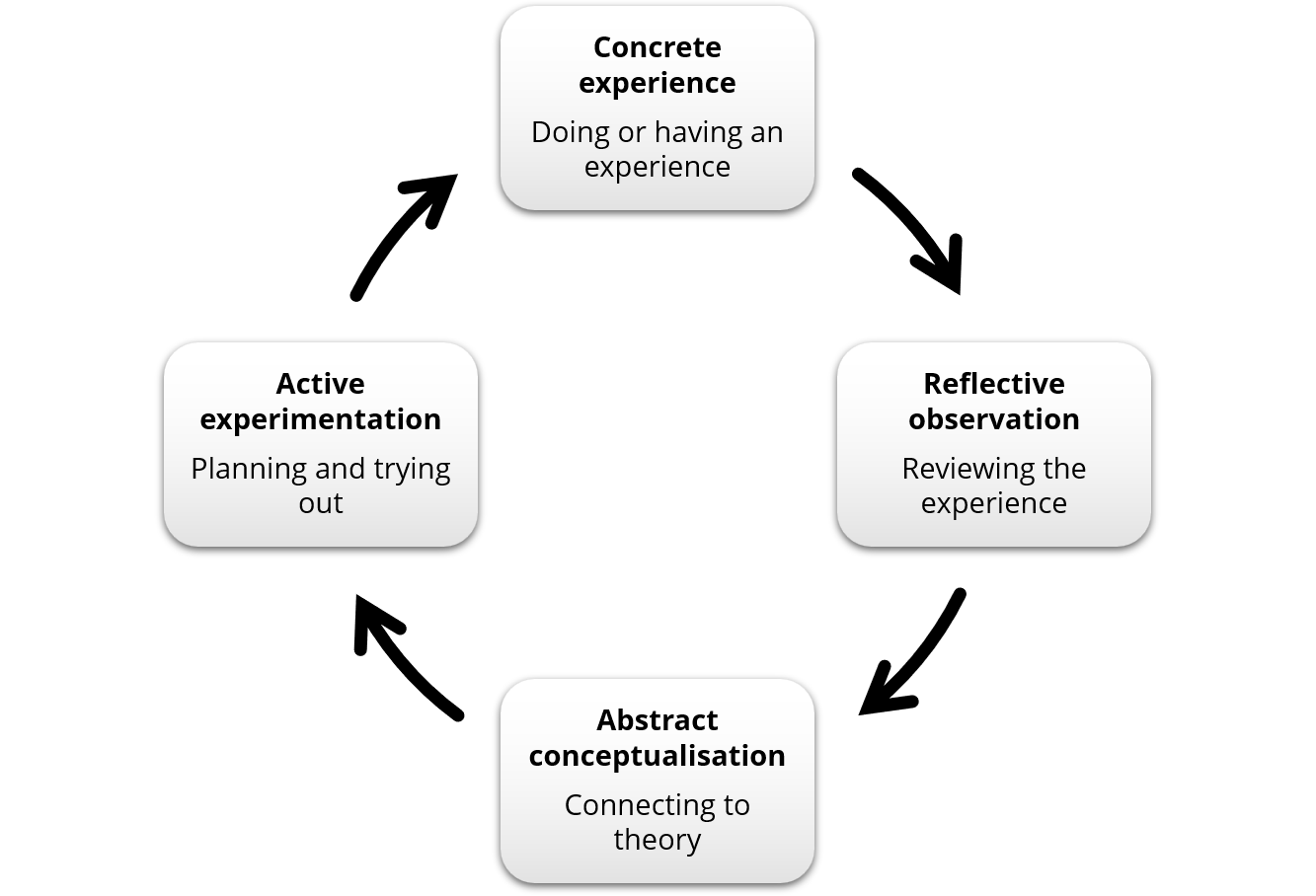
Kolb's model follows a four-stage cycle:
- concrete experience
- reflection
- theory connection
- planning
It works well when you have learned through doing — group projects, placements, or practical tasks.
Here is an example of Kolb's model in use.
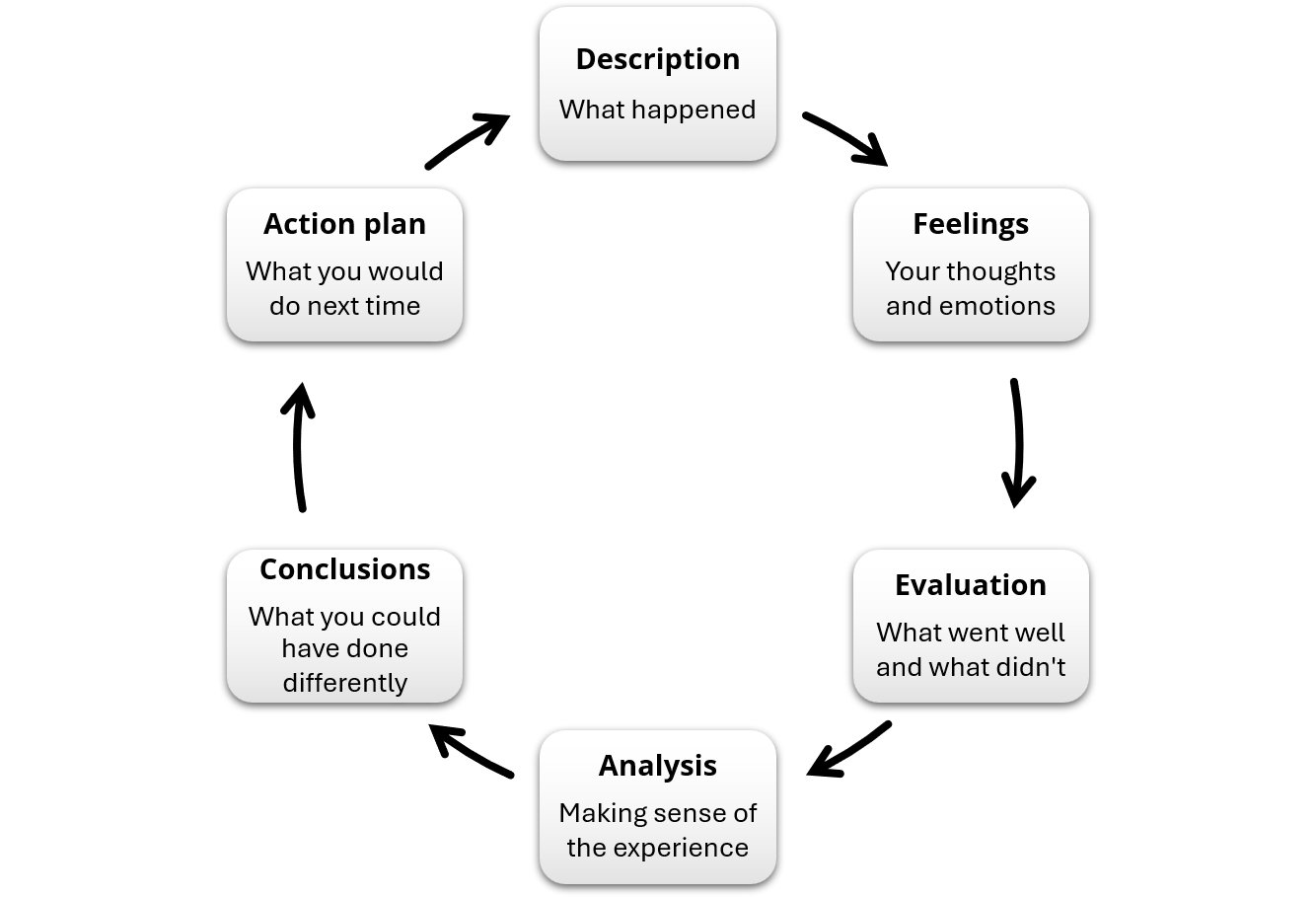
Gibbs' model guides you through six stages:
- description
- feelings
- evaluation
- analysis
- conclusion
- action plan
It's one of the most structured models available and works well for reflecting on a single, significant event.
Here is an example of Gibbs' model in use.
Schön's model focuses on two types of reflection:
- Reflection in action — noticing, responding, and adjusting during an event as it happens
- Reflection on action — considering what happened and why, after the event
It's particularly useful in practice-based disciplines where your in-the-moment decisions are worth examining. Comparing how you responded in the moment with how you might have responded with more time to think can reveal whether your actions matched your intentions.
Here is an example of Schön's model in use.
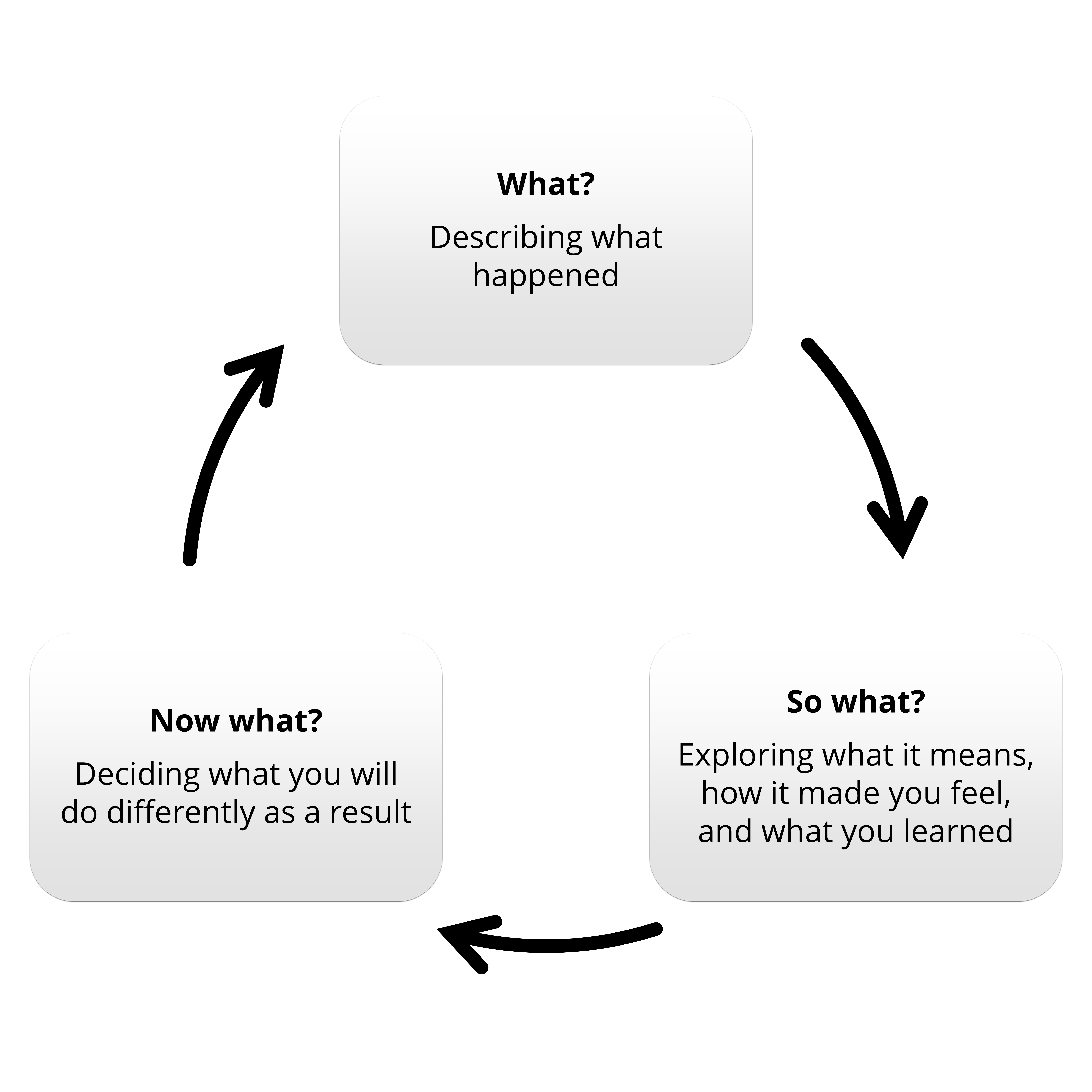
Driscoll's model organises reflection around three questions:
- What happened?
- So what does it mean?
- Now what will you do differently?
It's simple, flexible, and especially common in healthcare, social work, and other professionally regulated fields. Here is an example of Driscoll's model in use.
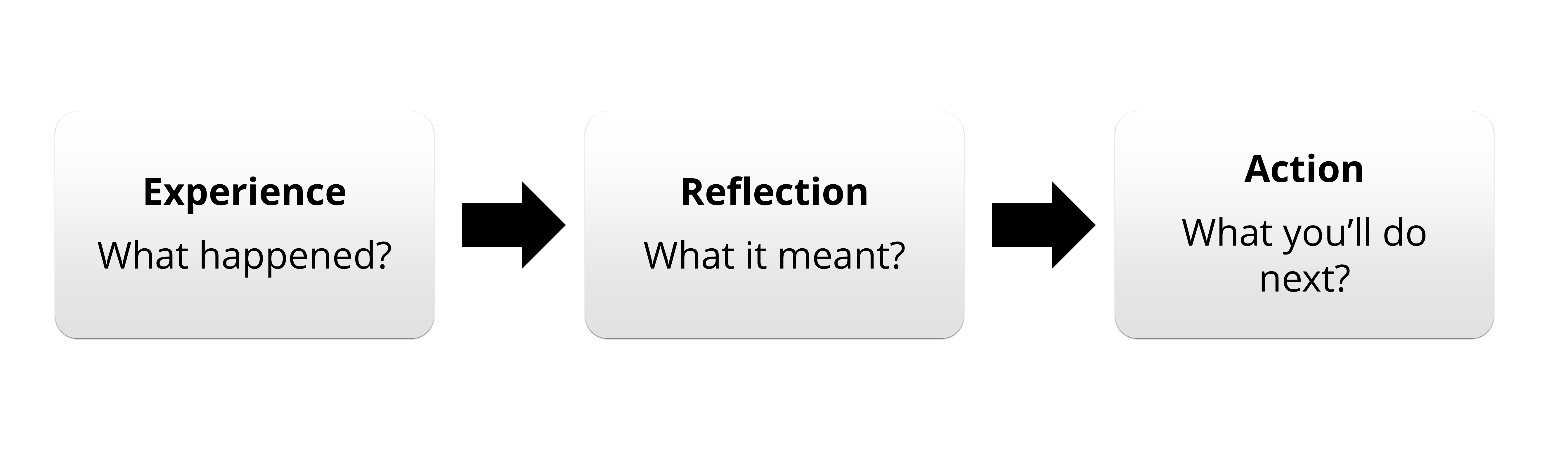
ERA stands for Experience, Reflection, Action. It's the most streamlined of the six models and suits assignments where a focused, concise reflection is required — particularly in practical or lab-based contexts.
Here is an example of the ERA model in use.
This model was developed by Rolfe et al. (2001).
References
Rolfe, G., Freshwater, D., & Jasper, M. (2001). Critical reflection for nursing and the helping professions: A user's guide. Palgrave Macmillan.
The referencing style used here is APA 7. Your course may require a different referencing system. Check your assignment brief or module guidance to confirm which style applies to you.
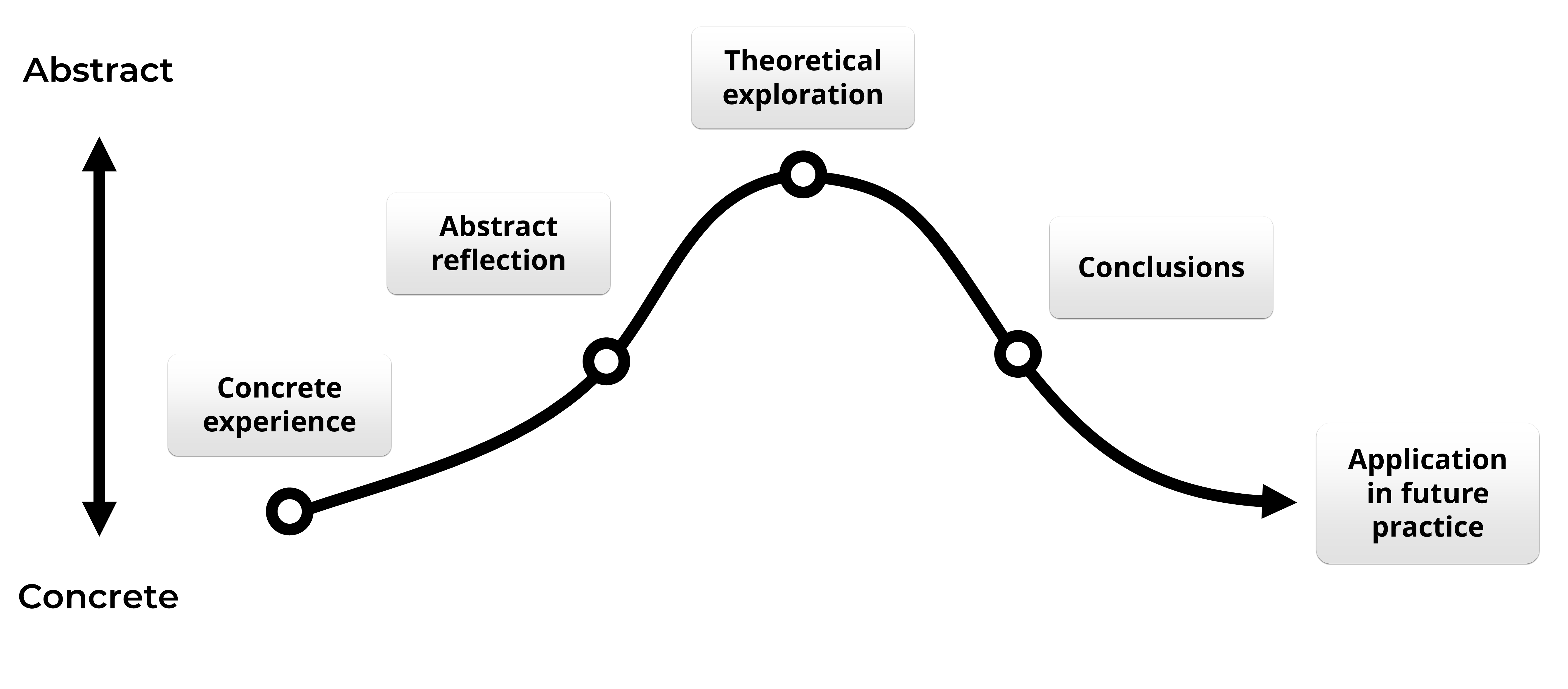
The reflective wave moves between concrete experience and abstract theory in a wave-like pattern. It suits longer or more complex assignments where your thinking developed gradually across multiple events or stages.
Here is an example of the reflective wave in use.
This model is based on Kirk (2017) and adapted by Johnson (2020).
References
Johnson, I. (2020, Jan 30). #Take5 #39: The best way to surf the reflective wave. Take5 blog. https://lmutake5.wordpress.com/2020/01/30/take5-39-the-best-way-to-surf-the-reflective-wave
Kirk, S. (2017). Waves of reflection: seeing knowledges in academic writing. In J. Kemp (Ed.). EAP in a rapidly changing landscape: issues, challenges and solutions. Proceedings of the 2015 BALEAP Conference. Garnet Publishing.
The referencing style used here is APA 7. Your course may require a different referencing system. Check your assignment brief or module guidance to confirm which style applies to you.
Connecting to theory and evidence
Start by finding themes in your experience. This makes it easier to find literature that helps you analyse what happened. Your reflection becomes academic when you support your ideas with evidence.
Using evidence analytically is covered in our guidance on Writing critically and Structuring paragraphs.
Examples
Kolb's experiential learning cycle
Early-stage example
During an early group project meeting, our group made very little progress. No one was taking the lead and everyone seemed to be waiting for someone else to start.1 The lack of clear roles meant people were unsure how to contribute, which caused the conversation to go in circles.2 Before our next meeting, I suggested we each take on a specific role and agree on a clear agenda in advance. The session was more focused and productive as a result.3 In future group projects, I will suggest agreeing on roles and an agenda from the beginning.4
Key
- Concrete experience Back to text, note 1
- Reflective observation Back to text, note 2
- Abstract conceptualisation Back to text, note 3
- Active experimentation Back to text, note 4
Advanced example
During an early group project meeting, our group made very little progress.1 No one was taking the lead. I noticed that some members were disengaged and not contributing. Others seemed unsure what they were supposed to be doing.2 In researching why this had happened, I found Belbin's team role theory (Moultrie, n.d.), which suggests that assigning roles based on individual strengths improves team performance. This helped me understand why the meeting had gone so badly. Without clear roles, people had no way to use their different strengths. Everyone waited rather than contributing.3 Before our next meeting, I proposed assigning specific roles based on each person's strengths. We also agreed a clear agenda in advance. The session was more organised and everyone contributed actively. In future group projects, I will propose assigning roles at the start, so that everyone can contribute effectively from the beginning.4
Key
- Concrete experience Back to text, note 1
- Reflective observation Back to text, note 2
- Abstract conceptualisation Back to text, note 3
- Active experimentation Back to text, note 4
Reference
Moultrie, J. (n.d.). Belbin's team roles. Institute for Manufacturing, University of Cambridge. https://www.ifm.eng.cam.ac.uk/research/dmg/tools-and-techniques/belbins-team-roles
The referencing style used here is APA 7. Your course may require a different referencing system. Check your assignment brief or module guidance to confirm which style applies to you.
Gibbs' reflective cycle
Early-stage example
During a patient consultation on my dentistry placement, I struggled to explain a treatment plan clearly because the patient kept asking questions I hadn't anticipated. The supervising dentist had to step in to help.1 This made me feel embarrassed that I had not prepared thoroughly enough.2 The consultation did not go well. The patient may have felt confused or uncertain about their treatment.3 Reflecting on this, I realised I had prepared for the clinical steps but not for how to explain them clearly to the patient.4 Good preparation means thinking about how to explain treatment clearly, not just knowing the clinical steps.5 Next time, I will think through the questions a patient might ask. I will practise explaining the treatment in plain language before the consultation begins.6
Key
- Description Back to text, note 1
- Feelings Back to text, note 2
- Evaluation Back to text, note 3
- Analysis Back to text, note 4
- Conclusions Back to text, note 5
- Action plan Back to text, note 6
Advanced example
During a patient consultation on my dentistry placement, I struggled to explain a treatment plan clearly and the supervising dentist had to intervene. This was because the patient kept asking questions I had not anticipated.1 This left me feeling embarrassed. I was also concerned that my struggles to answer the patient's questions might have made them more anxious about their treatment.2 The patient did not get the clear explanation they needed. This may have affected their trust in the treatment plan.3 Reflecting afterwards, I realised I had focused on delivering information rather than checking whether it was being understood. Silverman et al. (2013) argue that effective clinical communication means balancing information-giving with relationship-building. I had not prepared for this, which left me unable to respond when questions escalated.4 Clinical communication requires attending to the patient's understanding and emotional state throughout, not just delivering information.5 In future consultations, I will prepare plain language explanations in advance. I will also check regularly whether the patient has understood and feels reassured.6
Key
- Description Back to text, note 1
- Feelings Back to text, note 2
- Evaluation Back to text, note 3
- Analysis Back to text, note 4
- Conclusions Back to text, note 5
- Action plan Back to text, note 6
Reference
Silverman, J., Kurtz, S., & Draper, J. (2013). Skills for communicating with patients (3rd ed.). Routledge. https://ebookcentral.proquest.com/lib/portsmouth-ebooks/detail.action?docID=4742673
The referencing style used here is APA 7. Your course may require a different referencing system. Check your assignment brief or module guidance to confirm which style applies to you.
Schön's reflective practitioner
Early-stage example
During a teacher training placement, I was leading a class discussion when I noticed several students seemed disengaged. I continued with my planned questions, hoping the discussion would improve. It did not, and the session ended without much useful conversation.1 Reflecting afterwards, I realised I should have stopped earlier and asked the group what they found confusing. Noticing how students are responding is as important as planning carefully. Being ready to change your approach matters too.2
Key
- Reflection in action (during the event) Back to text, note 1
- Reflection on action (after the event) Back to text, note 2
Advanced example
During a teacher training placement, I was leading a class discussion when I noticed several students seemed disengaged. I continued with my planned questions, hoping the discussion would improve. It did not, and the session ended without much useful conversation.1 Reflecting afterwards, I realised I had focused on following the plan rather than responding to what I observed. Schön (1991) calls this the gap between what we believe we should do and what we actually do. I intended to be student-centred, but when it mattered I followed the lesson structure instead. Pollard et al. (2019) argue that effective reflective teaching means paying attention to how students are engaging throughout a lesson. Planning carefully is not enough on its own. In future lessons, I will pause regularly to check for understanding. This will help me adjust my approach before students lose interest.2
Key
- Reflection in action (during the event) Back to text, note 1
- Reflection on action (after the event) Back to text, note 2
References
Pollard, A., Black-Hawkins, K., Cliff Hodges, G., Dudley, P., Higgins, S., James, M., Linklater, H., Swaffield, S., Swann, M., Winterbottom, M. and Wolpert, M.A. (2019). Reflective teaching in schools (5th ed.). Bloomsbury.
Schön, D. A. (1991). The reflective practitioner: How professionals think in action. Ashgate Publishing Ltd.
The referencing style used here is APA 7. Your course may require a different referencing system. Check your assignment brief or module guidance to confirm which style applies to you.
Driscoll's model of reflection
Early-stage example
During a social work placement, I was uncomfortable with how my supervisor dealt with a home visit. I felt the approach was too formal and that the family were not given enough time to speak. I did not raise this at the time or afterwards.1 Reflecting on this, I stayed silent because I did not want my supervisor to think I was criticising their approach — but I wish I had said something afterwards. Asking questions when something is unclear is how professional understanding develops. I also recognise that I was not yet confident enough to frame the question well. Raising it in front of the family would also have been inappropriate. What matters is knowing how to phrase these questions and when to ask them.2 After future home visits, I will make time to ask my supervisor about decisions I did not understand. Approaching it as a question rather than a challenge should make the conversation easier.3
Key
- What? Back to text, note 1
- So what? Back to text, note 2
- Now what? Back to text, note 3
Advanced example
During a social work placement, I observed my supervisor manage a home visit in a way that made me uncomfortable. I felt the approach was too formal and that the family were not given enough time to speak. I did not raise this at the time or afterwards.1 Reflecting on this, I stayed silent because I did not want my supervisor to think I was criticising their approach — but I wish I had said something afterwards. Asking questions when something is unclear is how professional understanding develops. Discussing this in our placement group chat afterwards, one student suggested that framing questions as a desire to understand rather than a challenge to the approach makes these conversations easier to initiate. I also recognise that I was not yet confident enough to frame the question well. Raising it in front of the family would also have been inappropriate. What matters is knowing how to phrase these questions and when to ask them.2 After future home visits, I will make time to ask my supervisor about decisions I did not understand. Approaching it as a question rather than a challenge should make the conversation easier. Over time, this will help me develop the confidence to form my own professional judgements.3
Key
- What? Back to text, note 1
- So what? Back to text, note 2
- Now what? Back to text, note 3
ERA model
Early-stage example
During a sport and exercise science lab session, I was responsible for recording data during a VO2 max treadmill test. Partway through, I noticed a difference between two readings but wasn't sure what to do, so I carried on. The inconsistency affected the reliability of our final results.1 Reflecting on this, I realised I hadn't fully understood what to do if something unexpected happened during the test.2 Before my next lab session, I will read the full protocol in advance. This includes what to do if unexpected results arise.3
Key
- Experience Back to text, note 1
- Reflection Back to text, note 2
- Action Back to text, note 3
Advanced example
During a sport and exercise science lab session, our group measured VO2 max using an incremental treadmill test. I recorded the data, but partway through the test I noticed a discrepancy between two readings and was unsure whether to stop the test or continue. I decided to continue, but the inconsistency affected the reliability of our final results.1 Reflecting on this, I realised I had not fully understood what to do when unexpected results arise during a live test, and that I hesitated because I could not apply my theoretical knowledge under pressure. This connects to the concept of transfer of learning — the idea that knowledge learned in one context does not automatically apply in practice (Soderstrom & Bjork, 2015).2 In future lab sessions, I will review the full protocol before beginning, including the procedures for dealing with anomalies, so that I can respond more confidently next time.3
Key
- Experience Back to text, note 1
- Reflection Back to text, note 2
- Action Back to text, note 3
Reference
Soderstrom, N. C., & Bjork, R. A. (2015). Learning versus performance: An integrative review. Perspectives on Psychological Science, 10(2), 176–199. https://doi.org/10.1177/1745691615569000
The referencing style used here is APA 7. Your course may require a different referencing system. Check your assignment brief or module guidance to confirm which style applies to you.
Reflective wave
Early-stage example
I presented on social inequality for my sociology seminar. Despite my preparation, my classmates seemed bored and I struggled to explain the more difficult concepts.1 This left me feeling unsure about my understanding of the material.2 However, Cho (2013) explains that stage fright causes a stress reaction in the body that makes it harder to perform. This helped me understand why the more complex ideas were hardest to explain.3 Making the presentation more interactive might have helped the audience follow the ideas.4 Next time, I will spend more time practising the difficult concepts before the seminar. I will also include more discussion to keep the audience involved.5
Key
- Concrete experience Back to text, note 1
- Abstract reflection Back to text, note 2
- Theoretical exploration Back to text, note 3
- Conclusions Back to text, note 4
- Application in future practice Back to text, note 5
Advanced example
In a sociology seminar, I presented on social inequality. Despite preparing thoroughly, my classmates seemed disengaged and I struggled to explain the more difficult concepts.1 This left me feeling unsure about my understanding of the material. I began to doubt my grasp of theories like Bourdieu's concept of cultural capital. I think this added to my confusion during the presentation.2 Goffman (2021) argues that we constantly manage how others see us. Reading this made me realise I had focused too much on this during the presentation, which affected my delivery. In addition, Freire (2014) argues that learning works best through dialogue, but my one-way presentation gave the audience no chance to contribute.3 I need to balance self-awareness with genuine connection and encourage dialogue rather than one-way delivery.4 Next time, I will encourage class discussion to make the presentation more interactive and focus on genuine connection with the audience rather than managing how I am perceived.5
Key
- Concrete experience Back to text, note 1
- Abstract reflection Back to text, note 2
- Theoretical exploration Back to text, note 3
- Conclusions Back to text, note 4
- Application in future practice Back to text, note 5
References
Cho, M. (2013, October). The science of stage fright (and how to overcome it) [Video]. TED-Ed. https://www.ted.com/talks/mikael_cho_the_science_of_stage_fright_and_how_to_overcome_it
Freire, P. (2014). Pedagogy of the Oppressed (30th anniversary ed.). Bloomsbury.
Goffman, E. (2021). The Presentation of Self in Everyday Life. Knopf Doubleday. https://ebookcentral.proquest.com/lib/portsmouth-ebooks/detail.action?docID=6721863
The referencing style used here is APA 7. Your course may require a different referencing system. Check your assignment brief or module guidance to confirm which style applies to you.
Page last edited: 25 September 2026
Next review due: 29 July 2029