

Planning before you write helps you stay focused, structure your ideas, and produce a clearer first draft. The steps below show you how to do this for any assignment.
This resource builds on the ideas presented our notetaking guidance.
Jump to:
Essential guidance
1. Understanding the task
Be clear exactly what the assignment brief is asking. Identify the task words, content words, and limiting words in your brief, then turn these into a set of planning questions. Return to these questions at every stage of the process.
2. Finding and organising your ideas
Use your planning questions to guide your reading. Strategies for reading efficiently can help you work through sources quickly and decide what's relevant. As you read, note where sources agree, disagree, or present contrasting evidence — this is a key part of reading critically. Group what you find by theme before moving to step 3.
3. Planning your structure
You may want to try one of these two approaches to organise your ideas:
Option A: Question-led planning
- Write your central answer to the task in one sentence.
- List the three or four strongest points that support that answer.
- For each point, identify the pieces of evidence you'll use and note how they connect to the task.
Option B: Visual mapping
You may already use mind mapping when doing notetaking — the same approach works here to map your ideas before you write. At the planning stage, focus on showing how your ideas connect to each other and to the task, rather than simply listing them.
For guidance on building a central answer, go to Building a written argument.
See below for a variety of planning examples.
4. Writing your first draft
Use your plan to write a first draft. Start with the main body and complete it in stages — write to develop your ideas first, then redraft to make your points and themes clearer. Check each section connects back to the task. For more about this, go to our paragraph structure guidance.
Once the main body is written, you can focus on writing an introduction and conclusion that connect with it.
Planning examples
Example 1
Criminology
Assignment question
'Discuss how Edwin Sutherland challenged mainstream assumptions about crime and criminology.'
Central answer
Sutherland's sociological explanation is stronger than individual pathology accounts. Harm is concentrated among the powerful, not the poor, and criminal behaviour is learned rather than innate. However, Sutherland downplays individual-level differences in offending.
Main body structure
1. White collar crime
Laws should focus on punishing actions that are "the most morally and financially harmful to society", regardless of who commits them (Sutherland, 1940, p. 4; Braithwaite, 1985).
The most morally and financially harmful acts are committed by powerful businessmen and corporations, not by 'pitiable deviants' (Alalehto & Persson, 2013; Geis & Goff, 1983; Braithwaite, 1985; Sutherland, 1940).
However, financial offences fall under civil rather than criminal law, meaning white collar criminals are not treated as 'real criminals' — a contradiction that undermines how crime is defined and who is held accountable (Geis & Goff, 1983; Sutherland, 1940).
2. Differential association
Delinquency is learned through behaviour modelled by others, not from individual pathology (Cressey, 1952; Sutherland, 1940; Tierney, 2010).
Sutherland argued against the idea that criminality is caused by 'internal pathologies' — the assumption that offenders are simply 'born bad'. If criminal behaviour is learned, it cannot be reduced to a psychiatric condition to be 'cured' (Alalehto & Persson, 2013; Geis & Goff, 1983; Sutherland, 1940).
3. White collar crime leads to differential association
No existing theories of crime could account for white collar criminality, which led Sutherland to develop differential association theory as an explanation applicable across social classes (Sutherland, 1940).
If everyone is capable of criminal behaviour, criminality cannot be explained as a psychiatric condition to be 'cured' (Alalehto & Persson, 2013; Geis & Goff, 1983; Laub & Sampson, 1991; Sutherland, 1940).
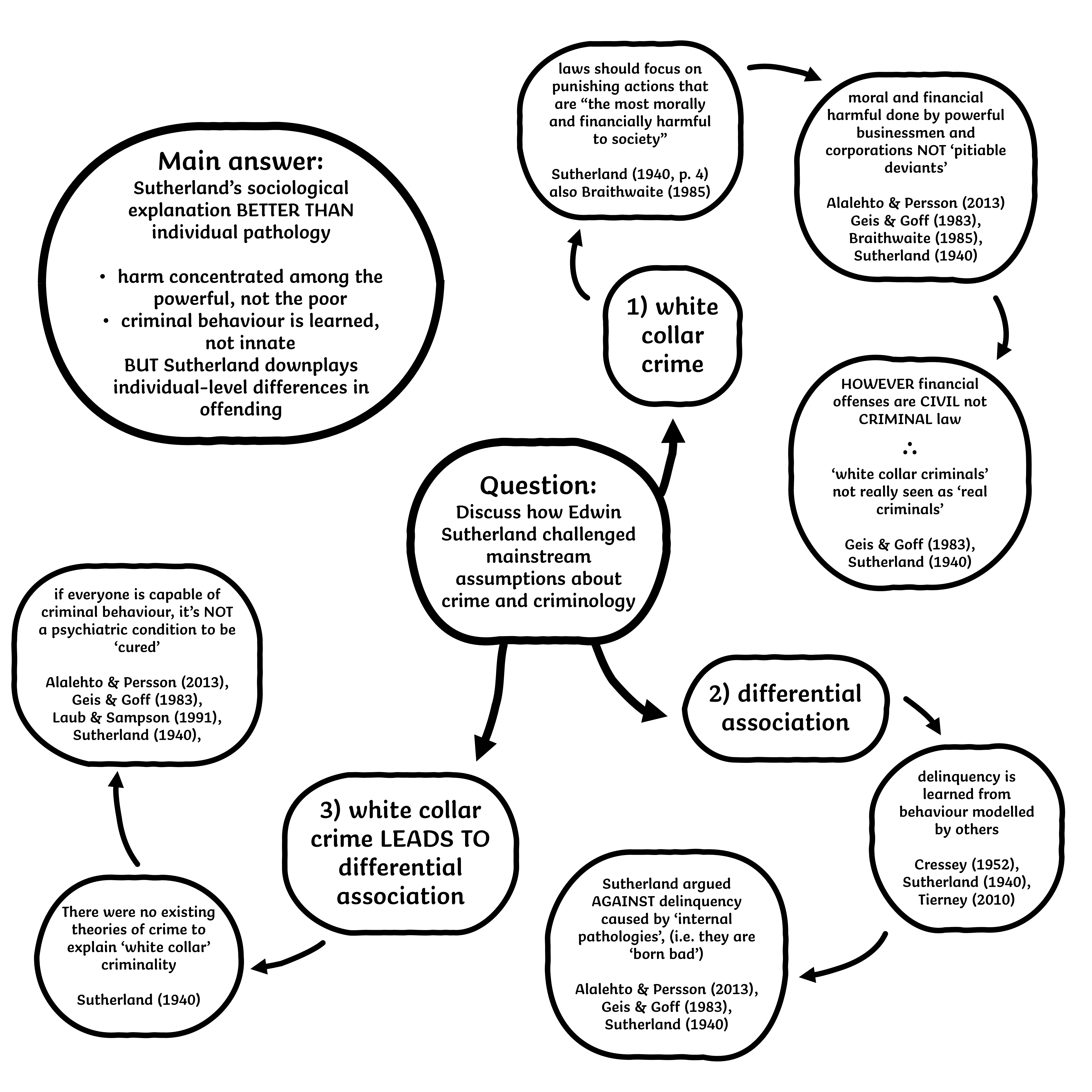
An example visual plan for a criminology assignment, showing three linked strands of argument supported by evidence.
Alalehto, T. I., & Persson, O. (2013). The Sutherland tradition in criminology: A bibliometric story. Criminal Justice Studies, 26(1), 1–18. https://doi.org/10.1080/1478601X.2012.706753
Braithwaite, J. (1985). White collar crime. Annual Review of Sociology, 11, 1–25. https://www.jstor.org/stable/2083283
Cressey, D. R. (1952). Application and verification of the differential association theory. Journal of Criminal Law, Criminology, and Police Science, 43(1), 43–52. https://scholarlycommons.law.northwestern.edu/jclc/vol43/iss1/4
Geis, G., & Goff, C. (1983). Introduction. In E. H. Sutherland, White collar crime: The uncut version. Yale University Press.
Laub, J. H., & Sampson, R. J. (1991). The Sutherland-Glueck debate: On the sociology of criminological knowledge. American Journal of Sociology, 96(6), 1402–1440. https://doi.org/10.1086/229691
Sutherland, E. H. (1940). White-collar criminality. American Sociological Review, 5(1), 1–12. https://doi.org/10.2307/2083937
Tierney, J. (2010). Criminology: Theory and context (3rd ed.). Pearson. https://doi.org/10.4324/9781315847191
The referencing style used here is APA 7. Your course may require a different referencing system. Check your assignment brief or module guidance to confirm which style applies to you.
Example 2
Psychology
Assignment question
'Examine the relationship between social media use and anxiety in adolescents.'
Central answer
Social media use is linked to adolescent anxiety because social comparison drives negative self-evaluation and cyberbullying exposure has direct psychological impact. However, most evidence is correlational, not causal.
Main body structure
1. Social comparison
Passive Facebook use predicts social comparison and envy, and envy leads to depression (Appel et al., 2016).
Adolescent wellbeing declined sharply after 2012, alongside rising screen time and reduced non-screen activity (Twenge et al., 2018).
Instagram-specific comparison is linked to social anxiety via reduced self-esteem (Jiang & Ngien, 2020).
2. Cyberbullying exposure
Cyberbullying is consistently associated with depression and anxiety across reviewed studies (Keles et al., 2020).
A longitudinal meta-analysis shows a weak positive association between cyberbullying and mental health symptoms across age and time (Lee et al., 2026).
Victims often do not disclose incidents due to fear of retaliation and low expectation that adults can help, which worsens psychological impact (Lee et al., 2026).
3. Weak causal evidence
Nearly all studies are cross-sectional, meaning association is shown but causation is not established (Keles et al., 2020).
Methodological variation across studies produces inconsistent findings, and causal claims are not well-supported (Orben & Przybylski, 2019).
Technology use explains at most approximately 0.4% of variance in adolescent wellbeing (Orben & Przybylski, 2019).
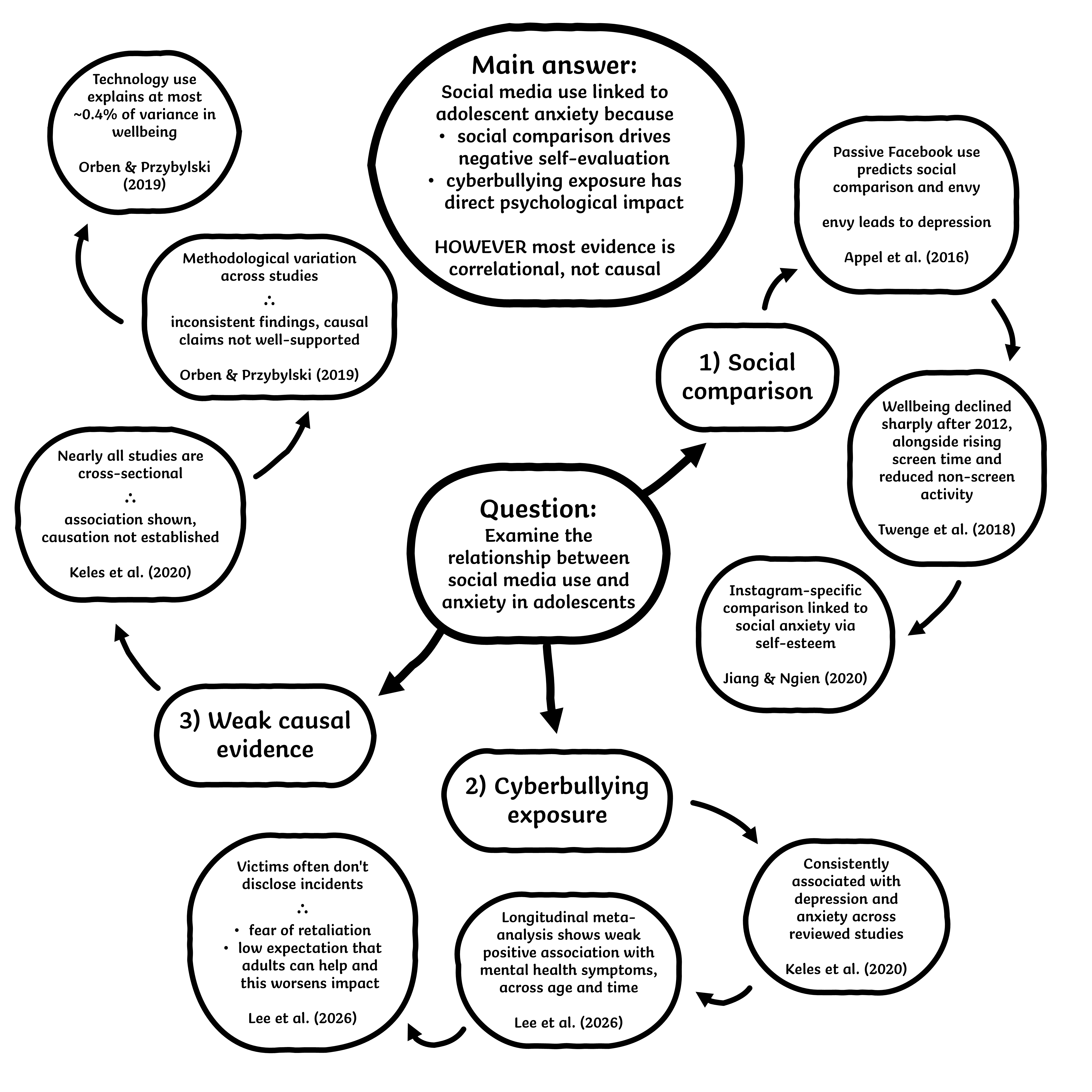
An example essay diagram plan for a psychology question, showing a central answer supported by three evidenced strands of argument.
Appel, H., Gerlach, A. L., & Crusius, J. (2016). The interplay between Facebook use, social comparison, envy, and depression. Current Opinion in Psychology, 9, 44–49. https://doi.org/10.1016/j.copsyc.2015.10.006
Jiang, S., & Ngien, A. (2020). The effects of Instagram use, social comparison, and self-esteem on social anxiety: A survey study in Singapore. Social Media + Society, 6(1). https://doi.org/10.1177/2056305120912488
Keles, B., McCrae, N., & Grealish, A. (2020). A systematic review: The influence of social media on depression, anxiety and psychological distress in adolescents. International Journal of Adolescence and Youth, 25(1), 79–93. https://doi.org/10.1080/02673843.2019.1590851
Lee, J., Choo, H., Zhang, Y., Cheung, H. S., Zhang, Q., & Ang, R. P. (2026). Cyberbullying victimization and mental health symptoms among children and adolescents: A meta-analysis of longitudinal studies. Trauma, Violence, & Abuse, 27(2), 391–406. https://doi.org/10.1177/15248380241313051
Orben, A., & Przybylski, A. K. (2019). The association between adolescent well-being and digital technology use. Nature Human Behaviour, 3(2), 173–182. https://doi.org/10.1038/s41562-018-0506-1
Twenge, J. M., Martin, G. N., & Campbell, W. K. (2018). Decreases in psychological well-being among American adolescents after 2012 and links to screen time during the rise of smartphone technology. Emotion, 18(6), 765–780. https://doi.org/10.1037/emo0000403
The referencing style used here is APA 7. Your course may require a different referencing system. Check your assignment brief or module guidance to confirm which style applies to you.
Example 3
Business
Assignment question
'Analyse why Blockbuster failed to compete with Netflix.'
Central answer
Blockbuster failed to adapt its business model because disruptive innovation from Netflix undercut it and consumer behaviour shifted away from physical rental. However, its revenue model made adapting a structural trap.
Main body structure
1. Disruptive innovation
Netflix DVD-by-mail targeted customers annoyed by late fees, making it a classic low-end market entry (Christensen, 1997).
Netflix beat competition on price and quality from the start, making this a 'big bang' disruption rather than gradual disruption (Downes & Nunes, 2013).
Blockbuster did not recognise the threat and declined to acquire Netflix for $50 million in 2000 (Davis & Higgins, 2013).
2. Consumer behaviour
Streaming availability has been shown to 'cannibalise' physical DVD sales, directly reducing them by 15–36% (Yu et al., 2022).
Disruption swept every customer segment at once, not just early adopters (Downes & Nunes, 2013).
3. Revenue model vulnerability
Late fees represented approximately 16% of Blockbuster's 2000 revenue — a major profit source (Davis & Higgins, 2013).
Netflix's no-late-fee model attacked Blockbuster's revenue source directly (Satell, 2014).
Dropping late fees and launching Blockbuster Online cost roughly $400 million combined — the price of attempting to escape the trap (Satell, 2014).
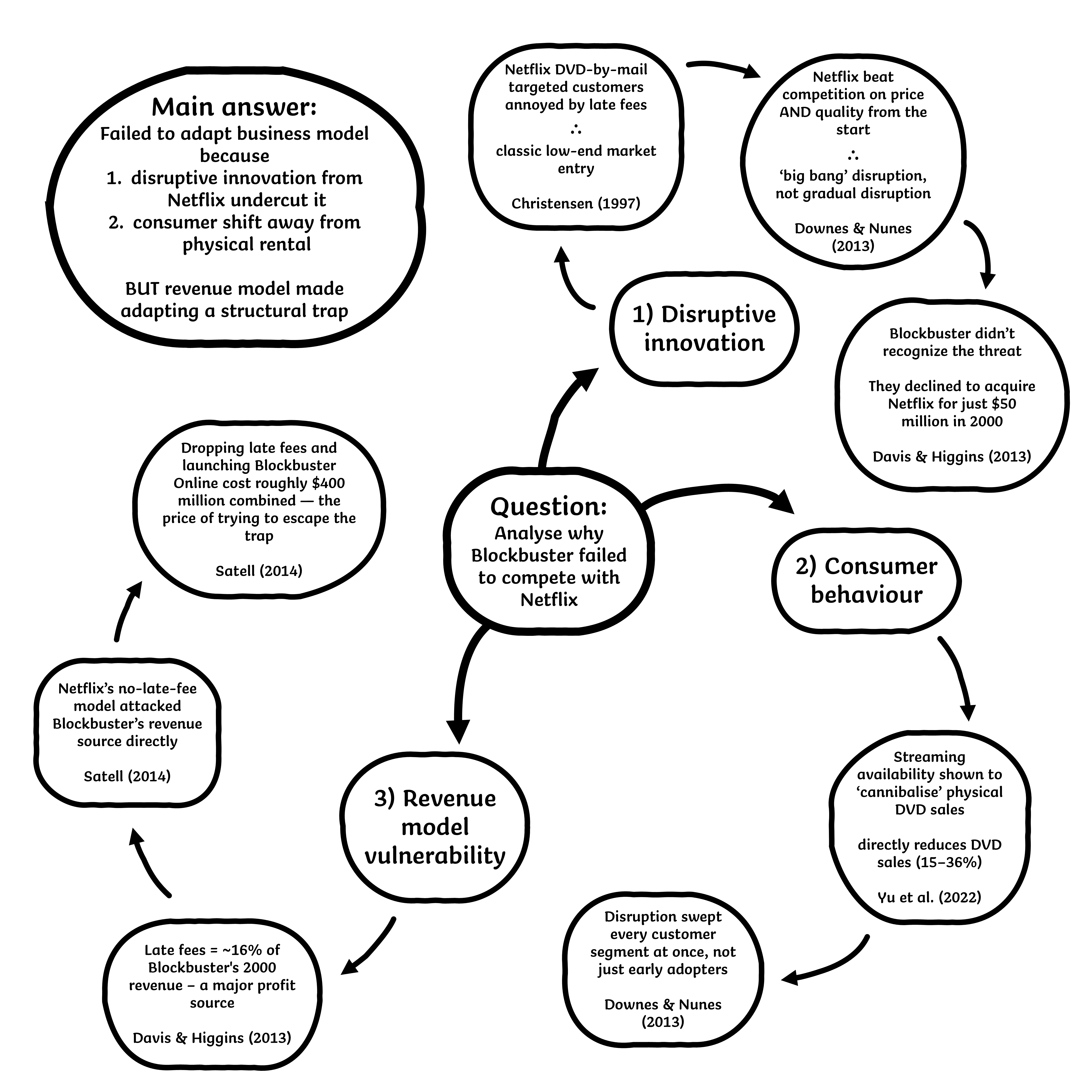
An example visual plan for a business assignment, showing a central answer supported by three evidenced strands of argument.
Christensen, C. M. (1997). The innovator's dilemma: When new technologies cause great firms to fail. Harvard Business School Press.
Davis, T., & Higgins, J. (2013). A Blockbuster failure: How an outdated business model destroyed a giant. Chapter 11 Bankruptcy Case Studies, 11. University of Tennessee College of Law. https://ir.law.utk.edu/utk_studlawbankruptcy/11
Downes, L., & Nunes, P. (2013, November 7). Blockbuster becomes a casualty of big bang disruption. Harvard Business Review. https://hbr.org/2013/11/blockbuster-becomes-a-casualty-of-big-bang-disruption
Satell, G. (2014, September 5). A look back at why Blockbuster really failed and why it didn't have to. Forbes. https://www.forbes.com/sites/gregsatell/2014/09/05/a-look-back-at-why-blockbuster-really-failed-and-why-it-didnt-have-to/
Yu, Y., Chen, H., Peng, C. H., & Chau, P. Y. K. (2022). The causal effect of subscription video streaming on DVD sales: Evidence from a natural experiment. Decision Support Systems, 157, Article 113767. https://doi.org/10.1016/j.dss.2022.113767
The referencing style used here is APA 7. Your course may require a different referencing system. Check your assignment brief or module guidance to confirm which style applies to you.
Example 4
Engineering
Assignment question
'Evaluate the suitability of two materials for use in the construction of a lightweight structural component for an aerospace application.'
Central answer
Carbon Fibre Reinforced Polymer (CFRP) is more suitable than aluminium alloy for this application because of its superior strength-to-weight ratio and favourable long-term life-cycle performance. However, it carries higher manufacturing costs.
Main body structure
1. Strength-to-weight ratio
CFRP composites achieve 30–50% weight reduction and 20–25% fuel savings compared to aluminium and titanium alloys (Mamat et al., 2025).
Lower component weight results in reduced fuel consumption and emissions over the operational life of the aircraft (Atescan-Yuksek et al., 2024).
2. Manufacturing cost
CFRP requires specialist curing facilities and skilled fabrication, resulting in higher production costs compared to aluminium (RS Components, 2025).
However, CFRP cost is offset over service life — aluminium components are more expensive to repair over time, with a break-even point at approximately 300,000 km (Atescan-Yuksek et al., 2024).
3. Application context
CFRP fuselage construction, as seen in the Boeing 787, reduces structural weight by roughly 20% compared to aluminium alloys (Mamat et al., 2025).
Aluminium alloys show good corrosion and fatigue resistance and strong recyclability, supporting long-term aircraft service life and making them suitable for less weight-critical components (Li et al., 2023).
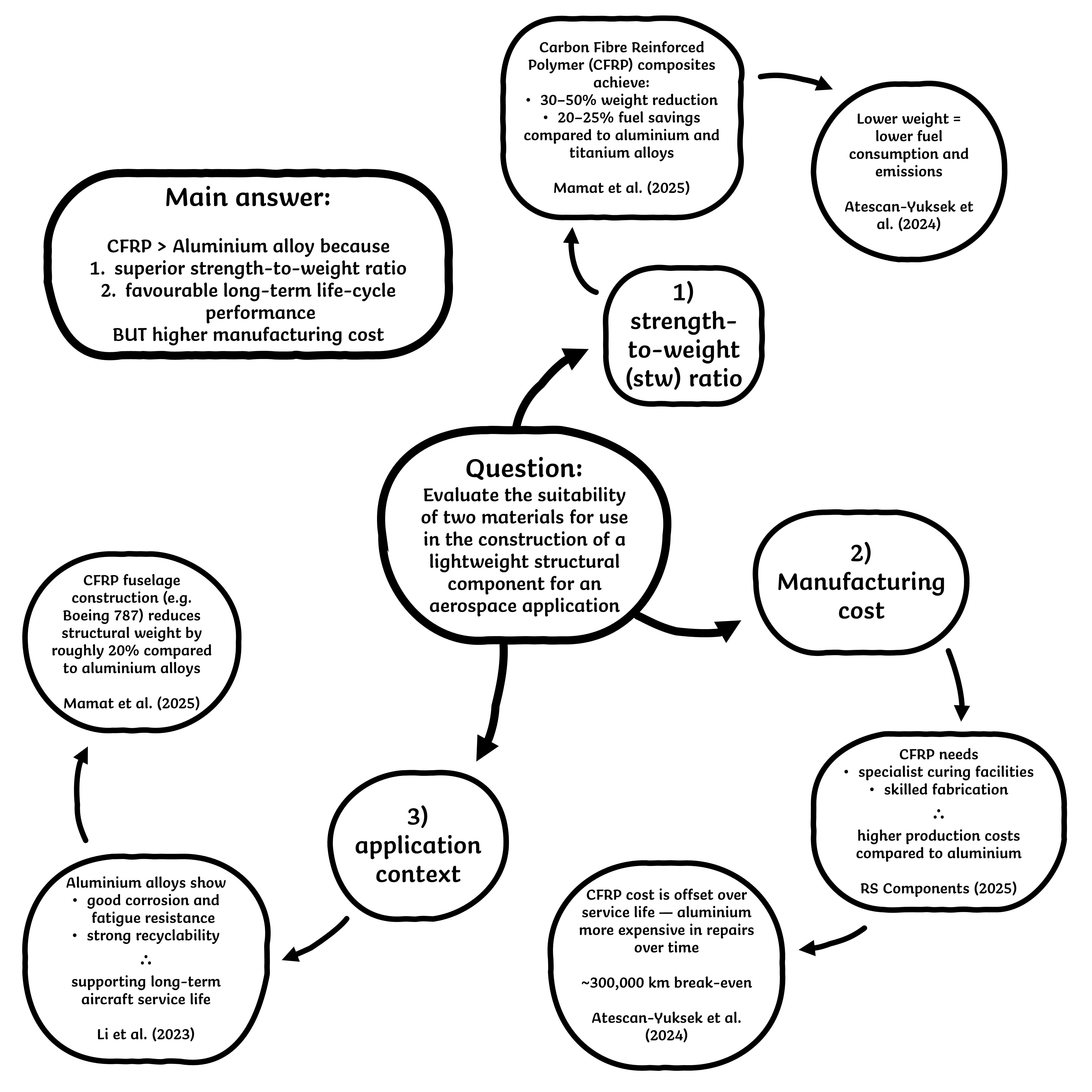
An example visual plan for an engineering assignment, showing a central answer supported by three evidenced strands of argument.
Atescan-Yuksek, Y., Mills, A., Ayre, D., Koziol, K., & Salonitis, K. (2024). Comparative life cycle assessment of aluminium and CFRP composites: the case of aerospace manufacturing. International Journal of Advanced Manufacturing Technology, 131, 4345–4357. https://doi.org/10.1007/s00170-024-13241-3
Li, S., Yue, X., Li, Q., Peng, H., Dong, B., Liu, T., Yang, H., Fan, J., Shu, S., Qiu, F., & Jiang, Q. (2023). Development and applications of aluminum alloys for aerospace industry. Journal of Materials Research and Technology, 27, 944–983. https://doi.org/10.1016/j.jmrt.2023.09.274
Mamat, R., Mohd Rashid, M. I., Syahir, A. Z., Erdiwansyah, Yusop, A. F., & Tamimi, A. (2025). Carbon fibre for applications in aerospace: A review. Journal of Alloys and Metallurgical Systems, 12, Article 100227. https://doi.org/10.1016/j.jalmes.2025.100227
RS Components. (2025). Carbon fibre vs aluminium: Strength-to-weight ratio. RS Technical Library. https://uk.rs-online.com/web/content/discovery/ideas-and-advice/carbon-fibre-vs-aluminium-strength-to-weight
The referencing style used here is APA 7. Your course may require a different referencing system. Check your assignment brief or module guidance to confirm which style applies to you.
Page last edited: 26 August 2026
Next review due: 8 August 2029